Cleft Grafting Fig Trees: One Tree, Multiple Varieties, Endless Possibilities
Rigo • 12 Oct 2026 • 15There is something incredibly satisfying about walking into your garden and seeing a fig tree producing several different varieties from the same trunk. Imagine harvesting a dark-skinned fig from one branch, a green-skinned variety from another, and perhaps an entirely different flavor profile from a third. For fig collectors with limited growing space, this isn't just an interesting idea. It's something that can be accomplished through grafting, and one of the most useful techniques to learn is called cleft grafting. Instead of rooting another cutting and finding room for another container, a grower can attach a desired cultivar to an established fig tree and allow the two pieces of plant material to grow together.
Grafting is certainly nothing new. Fruit growers have used different grafting techniques for centuries to preserve desirable cultivars and change the varieties growing on established trees. Fig grafting was described in considerable detail by horticulturist Gustav Eisen in his 1901 publication, The Fig: Its History, Culture, and Curing. Eisen discussed preparing fig scions, making clefts, positioning the graft, and allowing the living tissues of the two pieces to unite. His writing shows how seriously growers approached fig propagation more than a century ago. Although the materials used today have improved, the biological principles behind cleft grafting remain essentially the same: healthy plant material, accurate cuts, good cambium contact, and protection of the graft while the union heals.
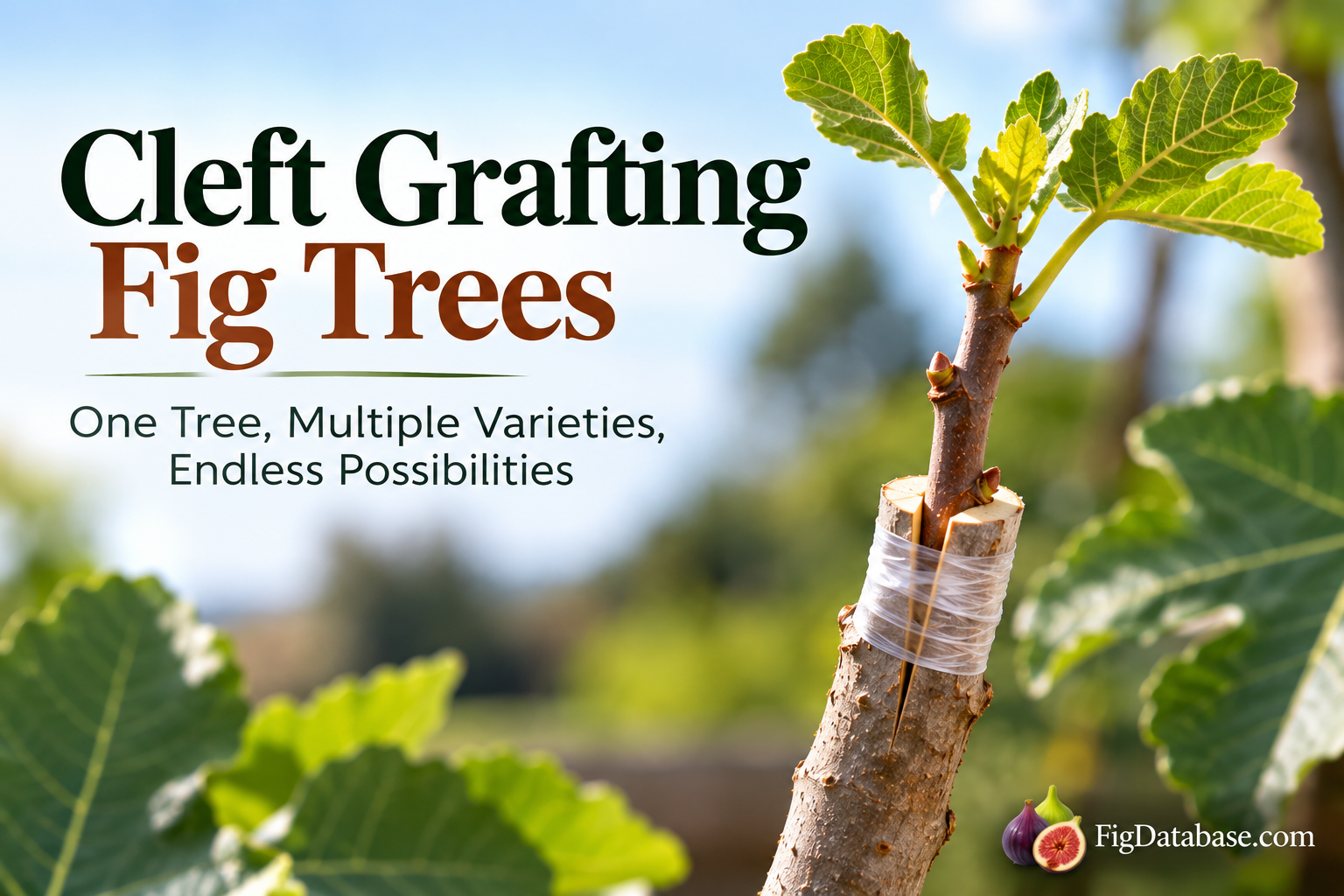
So what exactly happens during cleft grafting? The process involves joining a cutting, known as a scion, to another plant called the rootstock. The rootstock supplies the established root system, while the scion produces the shoots, leaves, and eventually fruit characteristic of the variety from which it was collected. In a cleft graft, the grower cuts the top of a suitable rootstock stem or branch, makes a vertical split in the exposed wood, and inserts the wedge-shaped base of the scion into that opening. If the tissues align properly and the graft is protected while healing, the two pieces can form a permanent union. This makes it possible to change the variety growing on an established branch without removing the entire tree.
The most important part of cleft grafting is proper cambium contact. The cambium is the thin living layer located between the bark and the wood, and it is the tissue responsible for producing new growth that allows the scion and rootstock to unite. When inserting the scion into the split rootstock, the two cambium layers need to touch along at least one side. The scion does not have to be exactly the same diameter as the rootstock, and in many cases it will be smaller. When that happens, the scion should be positioned slightly to one side rather than centered so the cambium layers line up as closely as possible. A clean cut, firm placement, and good cambium contact are far more important than making the graft look perfectly symmetrical from the outside.
Timing is another important consideration. Cleft grafting is commonly performed around the end of dormancy or the beginning of spring growth, when the rootstock is becoming active but the scion remains dormant. This allows the rootstock to support the formation of new tissue while reducing the risk of the scion losing moisture through developing leaves before the graft union is established. For fig growers, the ideal timing depends on local temperatures, growing conditions, and whether the tree is outdoors, in a greenhouse, or being managed in containers. Healthy scion wood, clean tools, and protection from drying are all essential ingredients for success.
Preparing a cleft graft doesn't require an expensive collection of equipment, but the quality of your cuts makes a tremendous difference. Start with a healthy fig tree or rooted plant that will serve as the rootstock, along with a firm, healthy scion from the cultivar you want to add. A scion approximately three to four inches long with two or three healthy buds is a practical starting point, although dimensions vary with the grafting method and the size of the stock. Using a sharp, sanitized grafting knife, carefully remove the upper portion of the rootstock and make a controlled vertical split. The lower end of the scion is then shaped into a smooth wedge that fits snugly into the opening. Position the scion so its cambium meets the cambium of the rootstock along at least one side. This alignment matters far more than making the outside bark look perfectly even. Because grafting involves sharp tools and controlled pressure, working on a stable surface and keeping your hands clear of the blade is especially important.
Once the scion is positioned, the next job is protecting the union. Parafilm, grafting tape, or another suitable wrapping material can help hold the graft securely while reducing moisture loss. Some growers also use grafting sealants to protect exposed surfaces. The goal is to keep the scion from drying out before the rootstock and scion establish a functioning connection. A graft that initially produces green buds is not necessarily successful, because stored moisture and energy inside the scion can support temporary growth. What matters is continued development and the formation of a healthy graft union. During the early healing period, protect the graft from excessive movement, strong wind, and unnecessary heat. As the graft thickens, check the wrapping periodically and remove or loosen any material that could eventually constrict the growing stem.
For collectors, one of the most exciting applications is topworking, which means changing the cultivar growing on an established tree by grafting new material onto it. Perhaps you have a vigorous fig tree that produces fruit you don't particularly enjoy, or you simply want to experiment with several cultivars without adding more containers to your garden. Rather than removing the original tree, you may be able to graft desirable varieties onto selected branches. Each successful scion retains the genetic identity of its original cultivar, meaning the grafted branch can eventually produce its characteristic fruit. However, it is worth remembering that the rootstock can influence growth and vigor, and different grafted varieties may grow at different rates. Careful pruning and balancing the canopy help prevent one vigorous branch from dominating the others. The graft union also needs time to strengthen before supporting heavy fruit loads.
There is one more habit that every serious collector should develop: labeling grafts immediately. When several cultivars are growing on the same tree, it becomes surprisingly easy to forget which branch belongs to which variety. A durable plant label and a simple garden record can prevent years of confusion. Recording the grafting date, scion source, cultivar name, rootstock, and eventual success or failure makes future experiments more useful. This is where Fig Database becomes particularly valuable, giving collectors a place to research cultivar information and compare observations before choosing which varieties to add. Readers can also explore the site's fig-growing glossary to learn terminology such as rootstock, scion, cambium, callus formation, and graft union.
Of course, not every cleft graft will succeed. Sometimes the scion dries out, the cambium layers fail to connect, the wood becomes infected, or the graft moves before a strong union develops. Even experienced grafters occasionally lose a promising cutting. Fortunately, fig trees are generally receptive to vegetative propagation, and a failed graft doesn't mean the grower should abandon the technique. With practice, better timing, and careful attention to clean cuts and moisture protection, results can improve considerably. For collectors who enjoy experimenting, the satisfaction of seeing a new scion produce healthy leaves and eventually its first ripe figs is difficult to beat.
Cleft grafting offers something especially appealing to fig enthusiasts: the opportunity to make an existing tree more interesting without constantly expanding the orchard. It connects today's hobbyists with generations of growers who experimented with the same basic technique long before modern grafting tapes and online tutorials existed. Whether you're changing an underperforming tree, preserving a treasured cultivar, or creating your own multi-variety fig tree, learning to graft is a skill worth developing. And who knows? The next time someone visits your garden and asks how many fig trees you have, you might smile and tell them that one of your trees has several varieties growing on it.
Comments 0
Leave a comment
Please log-in to comment