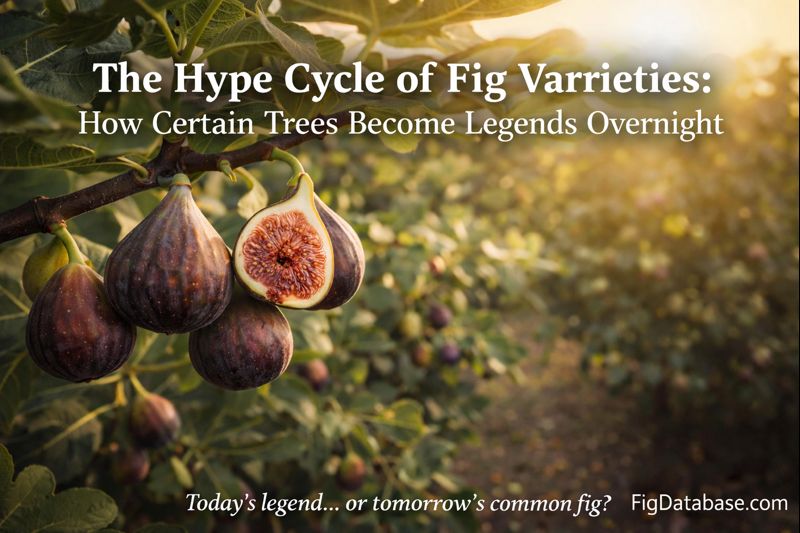
The Hype Cycle of Fig Varieties: How Certain Trees Become Legends Overnight
Rigo • 31 Jan 2026 • 594There’s a moment every fig collector remembers. Someone posts a photo of a perfectly ripe fig, split open just enough to show a glowing interior. Comments pour in. Questions follow. “What variety is that?” “Where did you get it?” “Is it available?” Within weeks, cuttings are trading hands, prices climb, and suddenly a previously obscure cultivar has achieved near-mythical status. Welcome to the hype cycle of fig collecting — a fascinating blend of horticulture, human psychology, and pure fruit-driven obsession.
Most hype begins innocently enough. A tree fruits exceptionally well in one climate. Someone shares tasting notes that mention intense sweetness or jammy texture. Another grower confirms similar results. Before long, the variety is being whispered about in messages and forums as a “top-tier” fig. Sometimes the reputation is well deserved. Other times, what’s really spreading is not a revolutionary cultivar but a familiar fig traveling under a new synonym, or a particularly vigorous strain of something already widely grown.
Because figs are propagated by cuttings rather than seed, nearly every named variety is a clone. That means subtle environmental differences — heat units, soil composition, irrigation schedules, pruning style — can dramatically change fruit quality. A fig grown in blazing summer sun with perfect water stress might taste extraordinary, while the same genetic tree in a cooler climate produces something merely good. When collectors forget that context, legends are born quickly.
Then there’s provenance. A cutting with a well-documented history — where it originated, who distributed it, how long it has been fruited — carries far more weight than an anonymous stick in a padded envelope. Savvy collectors pay attention to that paper trail, knowing that names alone don’t guarantee performance. A fig labeled as a rare Mediterranean import sounds exciting, but without solid documentation, it might just be a garden seedling that happens to resemble something famous.
Sports and mutations add another layer to the hype machine. Occasionally, a branch will throw fruit that ripens earlier, grows larger, or colors differently. Growers debate whether it’s stable enough to merit its own identity or simply a seasonal quirk. Some of these become genuinely distinct selections after years of consistent fruiting. Others quietly fade away when the tree reverts. The difference between the two is patience — something hype rarely allows.
Price is often where excitement turns dangerous for newcomers. When a fig becomes fashionable, cutting prices climb fast. A tree that sold for $20 last season might suddenly fetch ten times that amount, fueled by scarcity, demand, and fear of missing out. Veteran collectors tend to wait these cycles out. They know that many hyped figs eventually circulate widely, bringing prices back to earth once supply catches up with reputation.
What keeps the hobby healthy is careful comparison and long-term evaluation. Growing two suspected synonyms side by side, fruiting them for multiple seasons, documenting breba crops versus main crops, and observing whether pollination changes the fruit — these are the slow, unglamorous processes that separate fact from folklore. It’s also where community-driven databases and shared records become invaluable, helping collectors make informed decisions rather than chasing every trending name.
In the end, the hype cycle isn’t entirely a bad thing. It reflects passion. It shows how deeply people care about flavor, performance, and discovery. But the wisest fig collectors learn to enjoy the excitement without letting it dictate every purchase. Sometimes the best fig in your orchard isn’t the one everyone’s talking about this year — it’s the dependable tree that quietly produces incredible fruit, season after season, without needing a dramatic reputation to prove its worth.
Comments 0
Leave a comment
Please log-in to comment