




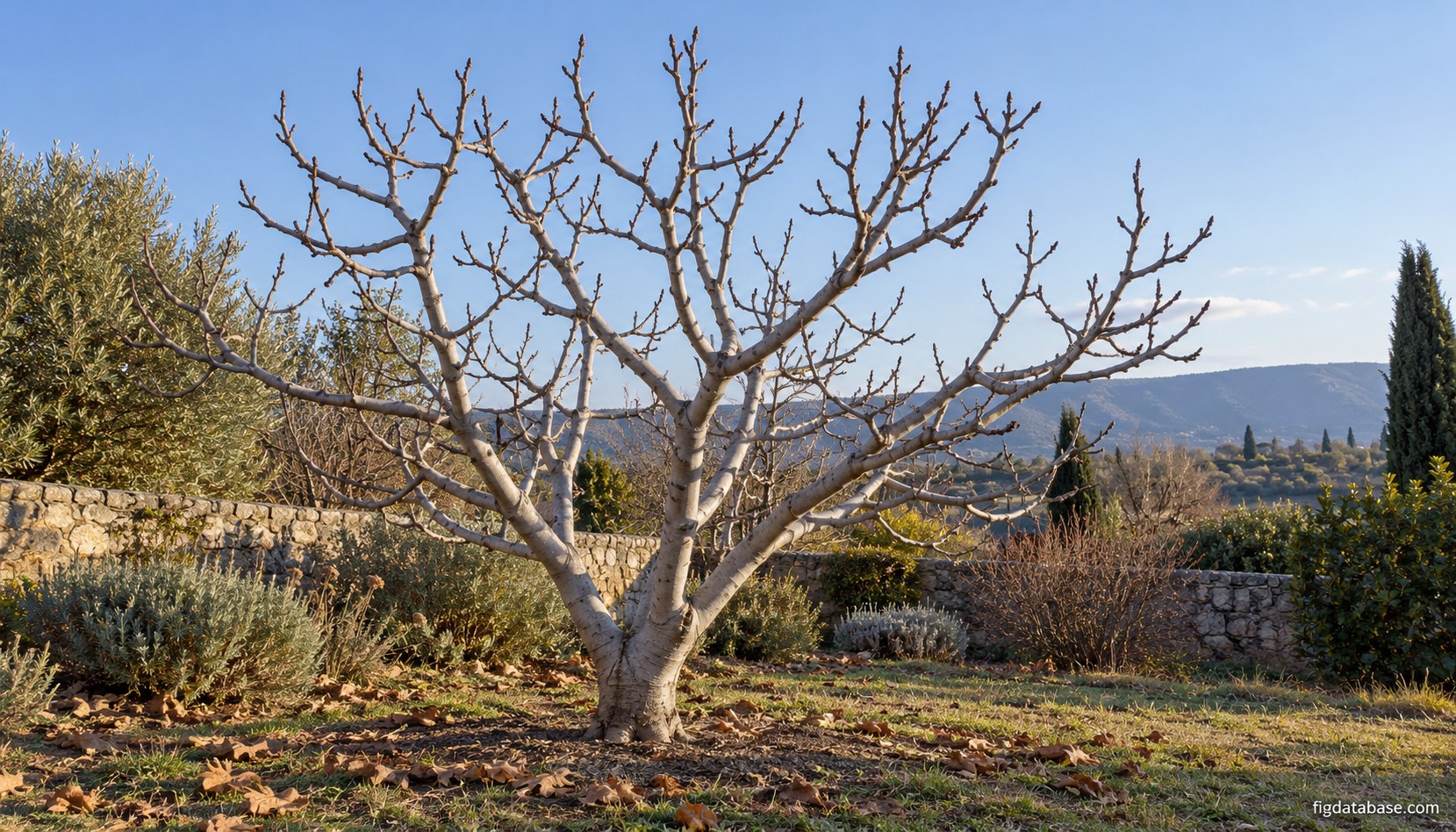
Deciduous by Design: What Fig Dormancy Does for the Tree
A bare branch is not an empty branch.
Fig Database Editorial • 20 Nov 2026 • 58A leafless fig tree invites an anxious question: is it resting, or has something gone wrong? In a seasonal climate, bare branches can be entirely ordinary. The leaves have gone, but buds and living tissues remain. Understanding that distinction changes winter care from a campaign to keep a tree visibly growing into an effort to carry living wood and roots through an unfavorable part of the year.
Ficus carica is deciduous. Leaf fall and the pause in visible growth belong to its seasonal behavior, although the timing depends on conditions. A tree losing leaves in autumn is not equivalent to one suddenly dropping its canopy during active summer growth. Observe the season, recent weather, and the plant's history before assuming that the same response explains both events.
Dormancy is more than a lack of leaves. Buds can pass through internal physiological states in which they do not immediately resume normal growth just because a brief warm spell arrives. Later, once those internal limitations have eased, unfavorable weather can still hold growth back. That distinction helps explain why a warm afternoon in winter is not a reliable signal to move a stored tree into summer conditions.
There is no sensible universal chill-hour number to attach to every fig in every setting. A study of five fig cultivars under artificial chilling found differing budburst responses under its test conditions. A detached-cutting experiment is useful evidence about physiology, but it does not establish one storage recipe for all whole trees, cultivars, or climates. Avoid turning an experimental treatment into an absolute garden rule.
Cold injury is a separate problem. A dormant tree is not immune to freezing damage, and survival of roots does not prove that every branch survived. Penn State's winterizing guidance discusses protecting figs in cold climates and the consequences of losing overwintered growth. Protection needs depend on the tree's size, exposure, growing method, and local weather, not merely the date printed on a calendar.
Container growers have an additional responsibility: roots above ground do not share the same insulation as roots in garden soil. Choose storage conditions suited to your climate and check the root ball occasionally rather than assuming a dormant plant needs no attention. The Iowa State hardy fig guide discusses sheltered overwintering for container trees. Moisture management still matters, but leafless plants should not be watered automatically as though they were fully leafed in summer.
When buds begin to grow, the care problem changes again. New shoots that developed under shelter have not experienced the same conditions as established outdoor foliage. Adjust exposure gradually and watch the forecast rather than assuming that visible budbreak means the frost risk is over. If some branches remain quiet, allow time for a clearer pattern before deciding which wood needs attention; a single late bud is not a complete diagnosis.
Keep a record of leaf fall, storage conditions, bud movement, and any winter damage. Over several seasons, those observations describe your tree more usefully than a borrowed claim that all figs need exactly the same rest. Dormancy is not wasted time between harvests. It is part of the tree's yearly rhythm, and respecting it can mean doing less while paying closer attention to the conditions that matter.
