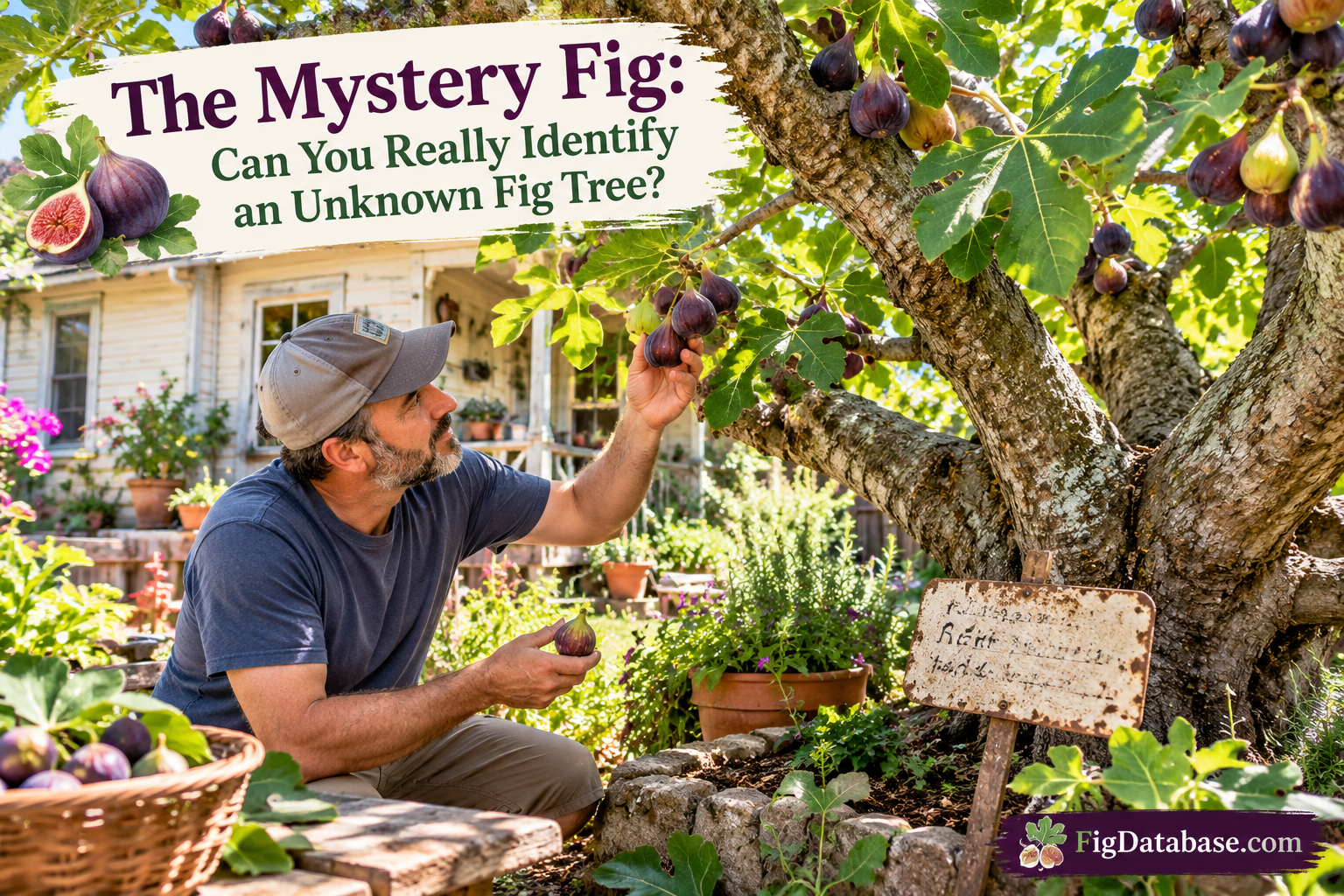
The Mystery Fig: Can You Really Identify an Unknown Fig Tree?
Rigo • 05 Oct 2026 • 4Every fig collector eventually encounters a mystery tree. It might be growing behind an old house, beside an abandoned building, on a family farm, or in the backyard of someone who simply calls it “Grandpa’s fig.” The tree may be decades old and produce incredible fruit every summer, yet nobody remembers its original name. Naturally, someone photographs the fruit, posts it online, and asks the question we have all seen: “What variety is this?” Within minutes the guesses begin. Brown Turkey, Celeste, Hardy Chicago, Brunswick, or perhaps something considerably rarer. Someone recognizes the leaves, another person is convinced by the fruit interior, and before long an unidentified tree can have half a dozen possible names attached to it. Unfortunately, identifying an unknown fig cultivar is rarely that simple.
A fig tree can provide plenty of useful clues. Collectors can document fruit size and shape, skin and pulp color, neck length, seed characteristics, ripening period, leaf patterns, growth habit, breba production, main crop characteristics, and the size and appearance of the ostiole. Observations made over several seasons can build a surprisingly detailed profile of an unknown tree. The problem is that many of these characteristics are not exclusive to one cultivar. Even leaf shape can be misleading because the same fig tree may produce leaves with noticeably different lobing. Young growth can differ from mature growth, while growing conditions can influence both the appearance of the tree and its fruit.
Fruit characteristics create another challenge. Heat, irrigation, soil, crop load, tree age, pruning, and pollination can influence fruit size, coloration, texture, and interior appearance. Two trees propagated from the same cultivar may produce figs that look surprisingly different when grown in very different climates. A pollinated fig may also look different from an unpollinated fruit of the same cultivar. This is why photographs are valuable evidence, but they usually aren't enough to establish an identification with confidence. Comparing several ripe fruits, leaves from different parts of the tree, crop timing, and several years of observations provides a much stronger foundation than matching a single photograph to something found online.
Sometimes the most valuable clue isn't hanging from the tree at all. It is the story behind it. Imagine finding a huge old fig beside a house built in the 1920s. The family remembers that their grandfather planted the tree after immigrating from Sicily, although nobody knows what he called it. That information doesn't magically reveal the cultivar, but it gives the tree something extremely useful: provenance. Knowing where a tree came from, approximately when it was planted, who maintained it, and how the original plant material may have reached the property can preserve information that would otherwise disappear. For an old heirloom fig, that history may eventually prove more useful than another close-up photograph of its fruit.
Sometimes, however, the most accurate identification really is simply unknown, and there is nothing wrong with that. An old tree doesn't become less interesting because its original label disappeared. In fact, an unidentified heirloom fig that has survived in the same neighborhood for generations can represent a fascinating piece of local horticultural history. Problems begin when guesses are turned into facts. A grower might find an unknown fig, compare it with photographs online, and decide that it resembles a particular named cultivar. Cuttings are then distributed under that name, the recipients eventually distribute more cuttings, and after enough time passes, the guessed identification begins to be repeated as though it were documented history. This is one way incorrect identities and supposed synonyms can become deeply embedded within collections.
The opposite problem occurs when someone assumes every interesting unknown tree deserves a completely new cultivar name. Finding an unnamed fig does not necessarily mean someone has discovered a genetically unique variety. It could easily be a known cultivar whose identity was lost decades ago. A temporary name connected to the tree's history is often more responsible. Calling something “Grandpa Russo's Unknown,” for example, preserves its story without pretending its genetic identity has been established. If stronger evidence emerges later, the record can always be updated. This is one reason careful documentation is so important to the fig community and why Fig Database places value on preserving histories, photographs, alternate names, introductions, and grower observations alongside the varieties themselves.
There is also something enjoyable about accepting that a mystery may remain a mystery. Fig collecting doesn't always have to revolve around acquiring famous cultivar names. Old fig trees are still growing in backyards, farms, forgotten orchards, and historic neighborhoods around the world, some carrying stories that have nearly disappeared along with the people who planted them. So the next time you discover an old tree loaded with delicious figs, resist the temptation to immediately attach a famous name to it—or invent a new one. Photograph it, observe it for several seasons, document its fruit and leaves, talk to the property owner, and ask older neighbors what they remember. You may never discover the name written on its original label, but by doing the research carefully, you might preserve something every bit as valuable: its story.
Comments 0
Leave a comment
Please log-in to comment