


Sub Categories
- Sponsorship Opportunities with Fig Database
Sponsoring a giveaway through FigDatabase.com is a unique opportunity to put your business in front of thousands of passionate gardeners, collectors, and fruit enthusiasts. Our community is dedicated to exploring and expanding the world of Fig varieties, connecting with trusted businesses, and engaging with high-quality products and services.
How Sponsorship Works
Unlike traditional sponsorships that require direct payment, becoming a Fig Database sponsor means contributing something of value to our community. As part of your sponsorship, we ask for a contribution from your business, which may include:
- A Fig tree or fruit from your collection
- Edible products related to Figes or tropical fruits
- A monetary donation to support Fig Database’s research and development
Sponsorships typically occur twice a year, offering businesses a meaningful way to gain exposure while supporting an innovative, growing platform for Fig lovers.
Your Benefits as a Sponsor
When you become a sponsor, your business will receive:
✅ Prime Homepage Exposure – Your logo, linked to your website, will be featured on the Fig Database homepage, ensuring maximum visibility to our visitors.
✅ Community Shoutouts – As time permits, we will highlight your sponsorship in our newsletter, giving you direct exposure to our dedicated members.
✅ Event Recognition – Your business name will be prominently featured in the giveaway or prize announcement, reinforcing your brand's presence within the Fig-growing community.By becoming a sponsor, you're not just promoting your business—you’re actively investing in a thriving, knowledge-driven network dedicated to advancing Fig research and cultivation.
If you're interested in sponsoring a giveaway and gaining valuable exposure for your business, send us a message today!
Your brand could be featured just like these are...
- Support Fig Database – Make a Difference
FigDatabase.com is more than just a website—it’s a community-driven movement dedicated to cataloging, researching, and sharing knowledge about Fig varieties from around the world. We strive to provide a free, accessible, and comprehensive resource for Fig growers, collectors, and enthusiasts, but we can’t do it alone.
Why Your Support Matters
Creating and maintaining Fig Database requires hundreds of hours of research, data collection, programming, and hosting services. Your financial contributions directly support:
✅ Ongoing Research & Expansion – Ensuring Fig Database remains the ultimate resource for Fig enthusiasts worldwide.
✅ Website Development & Hosting – Keeping the platform fast, user-friendly, and constantly evolving with new features.
✅ Community Growth & Engagement – Strengthening connections between Fig lovers through interactive tools, educational resources, and community-driven contributions.Your Donation is an Investment in a Growing Movement
By donating, you’re not just supporting a website—you’re fueling a global initiative that will transform the way we document, cultivate, and share Fig knowledge for generations to come.
We are at the forefront of an agricultural revolution, bridging the gap between Fig history, modern cultivation, and a new era of digital research. Every dollar contributed drives innovation, supports our mission, and strengthens the Fig community as a whole.
Ways to Support Fig Database
💛 One-Time Donations – Show your support with a single contribution of any amount. Every donation, big or small, makes a meaningful impact.
💛 Recurring Contributions – Become an ongoing supporter and help sustain Fig Database’s mission with a monthly donation.
💛 Business Sponsorships – Businesses and organizations can contribute by sponsoring giveaways or making direct contributions to Fig Database’s development.Be Part of Something Bigger
Fig Database is built on the power of the people—passionate growers, researchers, and collectors like you who believe in preserving and expanding Fig knowledge. Your donation isn't just a gift; it’s a commitment to the future of Fig research and an investment in an extraordinary, ever-growing community.
Make a difference today—support Fig Database and help us continue our mission!
- Tell Everyone About Yourself
You now have the option to write a short "About Me" on your own profile page.
- Using The Advanced Search Function
Created to be used with ease. Just like the basic search function, but with more details to select from. You can be even more specific using the advanced search function. 1) Select the "Advanced Search" button. This will extend the search menu. 2) Select any of the drop down bar options or bullet options available to conduct your search. 3) Click on the "Search" button and it will show you results according to your selected options.
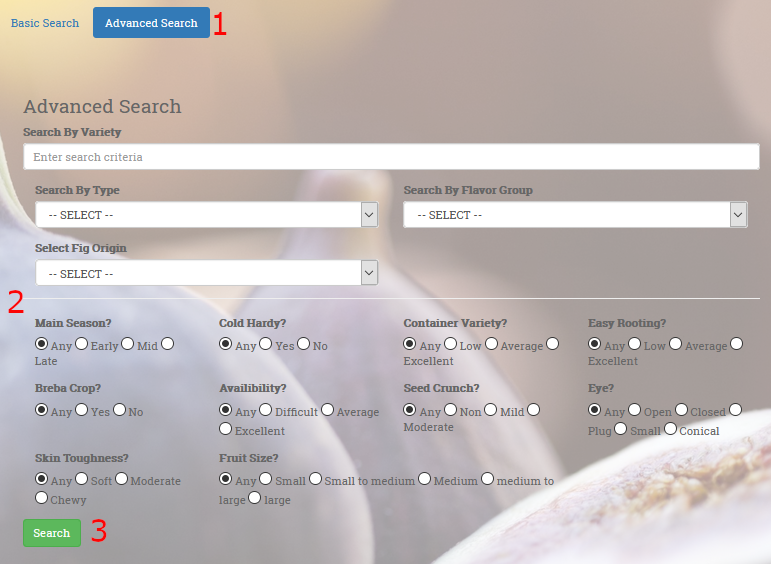
You can also combine your selection of options (e.g. selecting Search By Type: Common, Search By Flavor Group: Honey, Cold Hardy: Yes and clicking will redirect you to all varieties currently fitting those selected options).
- Variety Lists
Variety lists is an idea created by Fig Database to give the users the ability to track their entire collection and information within one place. Do research, add varieties, edit or share from anywhere they are at with the rest of the community. The lists are located (and mostly used thru) in the variety detail pages you visit as pictured below. Once you click on any of these tabs to add them to your list/s (located on your personal profile for management), the selected tabs will turn green, meaning they have been added to your list. The wording on these tabs will then change with the option to "remove from the list". If you click on any of the green tabs, it will then go back to no color, indicating it is not added to your list.

The lists consist of the following:
- Wishlist - You can add varieties to your own wishlist and while visiting a members profile page, look at what's in their wishlist.
- Collection - You can add varieties to your own collection and while visiting a members profile page, look at what's in their collection.
- Tasted - You can add varieties you've tasted before and add them to your list in this category. And as previousely mentioned, while on a members profile page, you can see what varieties they have tasted.
- Owned - You can add to this list varieties you have owned before and for whatever reason, no longer own.
Managing Your Lists
- Location and management of your lists is done thru your profile page. Here, you will be able to see your lists thru tabs, as pictured below.

- My Wishlist - Here is where you find varieties you have added thru the variety detail page by clicking on the "Add to wishlist" button.
- My Collection - Here is where you find varieties you have added thru the variety detail page by clicking on the "Add to collection" button.
- Under this tab, you will notice that each and every variety contains a "Catalog" button as pictured below.
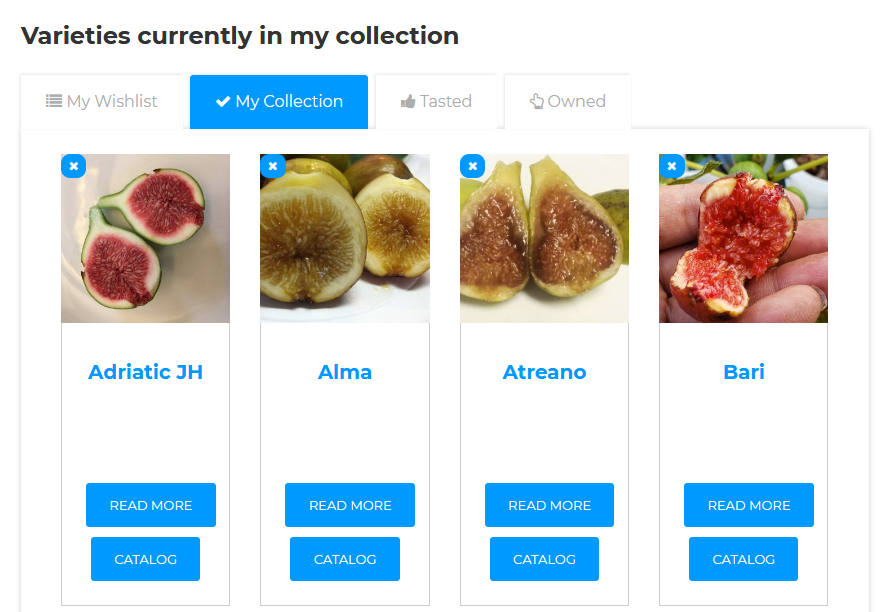
- Inside each catalog, you have a form (pictured below) with pre-made fields you can fill out to keep records and information of your varieties, hence making your collection manageble, organized and having it all in just one place for a quick look-up to read or make changes at any time. You can print or share your catalog at any time.

- Tasted - On this tab, you will see varieties you've added from the variety detail page which you have selected to add as varieties you have tasted before.
- Owned - Here are varieties you have added from the variety detail page in which you selected to add because at one point in time, you owned the specified variety.
- Under this tab, you will notice that each and every variety added to this list contains a "Notes" button as pictured below.
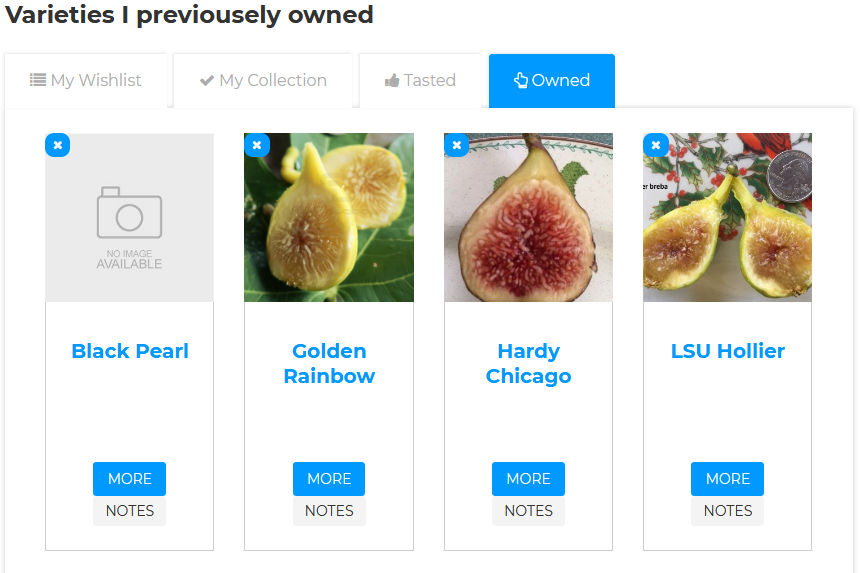
- Notes was added because if you're like me (Rigo), I like to have a note section to write a reason as to why the spific variety is no longer in my collection (why I got rid of it). When you click on the notes button, you will see a simple box to write your notes and then you can save, as pictured below.

- What are the best varieties of fig trees?
The answer to this question is up to the individual. But, there are some varieties of fig trees that have stood up to the test of time and are easy to acquire. Any of the fig tree varieties listed below do not require pollination, will perform great in a container, and can be easily trained into a tree or bush. If you’re new to fig trees you can’t go wrong with:
-
Strawberry Cypress - This has got to be the most perfect fig variety for those that have lots of rains, heat and humidity. Personally, it is the soldier of figs for South Florida.
-
Celeste - Cold hardy variety for the northeast but one of the best growers in the southeast. It’s great for hot and humid locations because there’s no splitting and a tight eye. Figs are brownish/purple and may vary by location to violet and blue. Light fig flavor and very, very, sweet; like sugar cubes. Very prolific. It’s easy to dwarf this variety in a pot and keep it growing in a tight bush.
-
Hardy Chicago - The name says it all; this variety has been around for decades and longer and is as cold hardy as they come. Good inground to USDA zone 6. Produces figs later in the season in a colder climate. Great mid-season producer in warmer zones. Medium sized brown/purple figs with a strong, sweet berry flavor. Great variety for potted culture. Very easy to propagate.
-
Marseilles Black VS - AKA, MBVS, Marseilles VS. Maybe slightly more cold hardy than Hardy Chicago and might be a good choice inground for USDA zone 5 in a protected location. Otherwise, MBVS is one of the best for potted culture and a reliable producer of figs. Very prolific. Produces medium-sized dark purple to black figs with tiny white spots and bright red pulp. Strong berry flavor.
-
Black Mission - As one of the first domesticated fig varieties introduced to the US, this variety packs a lot of history. Large dark purple figs with smooth skin and red pulp. Produces 2 nice crops of very sweet figs. Great for cooking. This is one of the few figs chosen by commercial growers because of its wonderful qualities. Commercial growers will pick the figs a little too early, though. Let this one hang on the tree to soften and you'll be rewarded with one of the sweetest treats. This variety does great in a pot but will perform better in-ground.
-
Ronde de Bordeaux - AKA, RdB. One of the first fig varieties to put on figs for the season. Ronde de Bordeaux produces 1 crop of dark purple to black, small-sized, round figs with red pulp. Great for eating fresh, making jam, baking, drying, and cooking. Thin skin, jammy texture, light seed crunch, sharp berry flavor that lingers, and very sweet. Extremely prolific. Be prepared for hundreds of figs, even when growing in a pot. Tight eye. Insect and moisture-resistant. Resists splitting even during times of heavy rains. Ronde de Bordeaux is a top-10 variety for potted culture.
-
Violette de Bordeaux - AKA, VdB. This is another fig variety whose history may date back to the 1600’s. At one time it was considered the best-tasting fig in the world. Cold hardy. Produces 2 crops of medium-sized dark purple/black figs with strawberry-colored pulp. 2nd crop is very heavy. The figs are juicy with strong berry flavors and a medium amount of sweetness. VdB has a small eye that resists insects. No splitting.
-
Atreano - Discovered and introduced in the late 1990’s. Atreano produces 2 crops of golden yellow to pale green, medium-sized figs with unique pink to amber-colored pulp that is juicy with a pleasing texture. Strong Honey/Berry flavor with light melon undertones. Very sweet. Thin skin and very easy to bite into. Small eye. Insect and moisture-resistant. Resists splitting even during times of heavy rains. Atreano is another top-10 variety for potted culture. Very prolific.
-
Desert King - If you’re in a cooler climate and can only get one or two fig trees, please consider Desert King. Desert King produces one early crop of large, dark green figs with tiny white spots and strawberry red pulp. The figs are simply sweet and delicious! Great for eating fresh and cooking. Vigorous grower and prolific. Very cold hardy variety.
-
Improved Celeste - Very cold hardy and one of the earliest to produce figs. This is definitely a top-5 pick for container growers and should be on everyone’s cool climate list. Improved Celeste comes from the LSU breeding program. Similar to Celeste in color with a bit of a longer neck. Pink/amber pulp and very, very sweet.
-
Nero 600M - Cold hardy. Fruit ripens perfectly in cooler temperatures. Nero 600M produces 2 crops of black, small to medium-sized high-quality figs with dark red-colored pulp. Very juicy with a pleasing texture. Wonderful fig flavor with hints of berries. Sweet through and through. Small eye. No souring or splitting. Very prolific. This is another reliable fig variety that will give you hundreds of delicious figs every season, even when growing in a pot. Easy to propagate and easily in the top-5 fig varieties for potted culture.
-
Strawberry Verte - AKA, Verte. This variety can’t help but make you smile. Strawberry Verte produces 2 crops of green, medium-sized figs with deep, strawberry-red pulp. The figs are a beautiful contrast of colors. Very jammy, pleasing texture, and a wonderful, rich fig flavor with hints of berries. Sweet through and through. Small eye and a high resistance to insects, souring, and splitting. Not as cold-hardy as some others but does well in-ground in USDA zone 7.
-
Green Ischia - Green Ischia is a vigorous and easy-to-root variety. Prolific and produces bowls of delicious, medium-sized green figs with jammy ruby-red pulp. Green Ischia has a nice fig flavor with deep strawberry undertones and a medium amount of sweetness. Very small eye. Rain and insect tolerant. Produces 2 crops of delicious figs. Great in-ground in USDA Zone 7a/b with winter protection.
-
Smith - Heirloom variety. There’s not enough that can be said about Smith and it should be included in every fig collection. Smith produces one (1) crop of high quality, blushed purple/red with streaks of yellow to light green colored, medium-sized turbinate shaped figs. The deep red-colored and juicy pulp has a pleasing texture and is usually filled with delicious sweet syrup. Very rich and complex flavors with strong berry undertones and an even amount of sweetness. Small to medium-sized eye that oozes a drop of clear honey when the fig is just ripe. Insect resistance and high rain tolerance. Moderate vigor with an average amount of growth every season. Not prone to splitting. Reportedly does well in-ground with no splitting and winter protected in USDA Zone 7b and below.
-
Yellow Long Neck - Yellow Long Neck is a prolific variety that produces 2 crops of large to extra-large, yellow figs with amber pulp. Light sweetness. Light and refreshing flavor with melon undertones. The solid pulp interior looks coarse but has a smooth, juicy texture. Small eye for such a large variety. Very filling; one or two figs are a meal. Very vigorous and prolific. Outgrows a pot very quickly. Great variety for inground.
-
Sal’s Corleone - This is another variety that should be in every fig collection. Sal’s Corleone produces 2 crops of roundish, blush to blood red and dark purple to black medium to large sized high-quality figs. When cut open there is a small cavity in the light strawberry-colored pulp. Very, very juicy with a pleasing texture. Nice fig flavor with hints of berries and a light amount of sweetness. Medium eye. Will develop a ‘star’ pattern split around the eye with too much rain. Split usually will not spoil the fruit and the occurrence decreases with age and will eventually disappear. Sal's Corleone is definitely a top-10 fig variety for potted culture.
-
Col de Dame Gris - AKA, CdDG. If you want to add a fancy variety to your collection at a moderate price, add Col de Dame Gris. Produces one (1) crop of high quality, purple(ish)/grey (heather purple?) colored figs. Small to medium-sized figs with thin, firm skin that does not damage easily. Easy to bite into. Deep red-colored pulp with no cavity. The pulp is dense and jammy with a pleasing texture and small seed crunch. Rich flavor with strong berry undertones and an even amount of sweetness. Very small-sized eye. Insect resistant, resistant to souring, and very rain tolerant. Moderate vigor with an average amount of growth every season.
-
Italian 258 - AKA, I258. One of the Italian numbered figs introduced to the fig-collecting community in the 1980’s. Considered one of the finest figs in the world for taste and looks. Italian 258 has a moderate amount of cold hardiness. Produces medium to large-sized dark purple and green figs. Figs will start to turn slightly bluish as the tree matures. Deep strawberry red, jammy pulp with a wonderful and complex figgy flavor. Strong berry undertones. Very sweet. Very prolific. With a little extra care, cool climate growers will be handsomely rewarded.
-
Violette de Sollies - AKA, VdS. Cold hardy. Violette de Sollies produces 2 crops of dark purple to black large-sized, round(ish) high-quality figs. When cut open the deep strawberry red-colored pulp contains a small cavity that is usually filled with a delicious amount of syrup. The pulp is very juicy with a pleasing texture. Rich flavor with strong non-acidic berry undertones and an even amount of sweetness. Ripens perfectly with a drop of honey appearing at the small eye. Very insect resistant. VdS is a top-10 fig variety for potted culture but will split with heavy rains. Does very well in-ground with no splitting and winter protected in USDA Zone 7.
-
- What does a fresh fig taste like?
A fresh fig offers a unique and delightful taste experience that can be difficult to describe but is often cherished by those who enjoy it. Here's a detailed look at the flavor profile of a fresh fig:
Flavor Profile:
-
Sweetness: Fresh figs are known for their natural sweetness, which is often compared to honey or jam. The sweetness can vary depending on the variety and ripeness of the fig, but it is typically quite pronounced.
-
Richness: Beyond sweetness, figs have a rich, almost syrupy quality. This richness makes them stand out compared to other fruits.
-
Subtle Tartness: Some figs have a hint of tartness or tanginess, which balances the sweetness and adds complexity to the flavor. This subtle tartness is usually more noticeable in less ripe figs.
-
Earthy Undertones: Fresh figs often have a mild, earthy undertone that adds depth to their flavor. This earthiness can be more prominent in certain varieties.
-
Nuttiness: There is a slight nutty flavor present in fresh figs, especially in the seeds. This nutty aspect complements the sweetness and adds a pleasant texture.
Texture:
-
Skin: The skin of a fresh fig is thin and delicate, with a slight chewiness. It is edible and contributes to the overall texture of the fruit.
-
Flesh: The flesh of a fig is soft, luscious, and juicy. It has a slightly grainy texture due to the tiny seeds, which are numerous but unobtrusive.
-
Seeds: The seeds inside a fig are tiny and add a subtle crunch to the otherwise smooth and creamy flesh. They are not hard and are easily chewed.
Aromatics:
Fresh figs have a mild, pleasant aroma that is slightly sweet and fruity. The scent can vary slightly between different fig varieties but is generally inviting and subtle.
Varietal Differences:
Different fig varieties can offer slight variations in flavor and texture. For example:
-
Black Mission Figs: Often very sweet with a rich, jammy flavor.
-
Brown Turkey Figs: Milder in flavor with a balance of sweetness and earthiness.
-
Kadota Figs: Less sweet, with a more delicate flavor and slight nuttiness.
-
Adriatic Figs: Very sweet, often described as having a honey-like flavor with a bit of tartness.
-
- Where can a fig tree grow?
Fig trees (Ficus carica) are quite adaptable and can be grown in a variety of climates and conditions, though they thrive best in certain environments. Here are some key points about where fig trees can grow:
Climate Zones:
-
USDA Hardiness Zones: Fig trees grow best in USDA hardiness zones 7-11. They can tolerate a range of temperatures but prefer warm climates with mild winters. In these zones, they can be grown outdoors year-round.
-
Mediterranean Climates: Fig trees are ideally suited to Mediterranean climates, which are characterized by hot, dry summers and mild, wet winters. This type of climate is found in parts of California, southern Europe, and other similar regions.
-
Subtropical and Tropical Climates: Fig trees can also thrive in subtropical and tropical climates, provided they receive enough sunlight and have well-draining soil.
Growing in Cooler Climates:
-
Container Growing: In regions with colder winters (zones 6 and below), fig trees can be grown in containers. This allows you to move the tree indoors or to a protected area during the winter months to prevent frost damage.
-
Cold Hardy Varieties: Some fig varieties are more cold-hardy and can tolerate cooler temperatures. Examples include 'Chicago Hardy' and 'Brown Turkey,' which can survive in USDA zone 6 with proper winter protection.
Site Selection:
-
Sunlight: Fig trees need full sun to produce the best fruit. They should be planted in a location that receives at least 6-8 hours of direct sunlight daily.
-
Soil: Fig trees prefer well-drained soil with a slightly acidic to neutral pH (6.0-7.0). They can grow in various soil types but require good drainage to prevent root rot.
-
Space: Ensure adequate spacing between fig trees to allow for proper air circulation and growth. Standard fig trees should be spaced 15-20 feet apart, while dwarf varieties can be spaced about 10 feet apart.
Indoor Growing:
-
Containers: Fig trees can be grown indoors in large containers, especially in climates where outdoor growing is not feasible year-round. Choose a pot with good drainage and use a high-quality potting mix.
-
Light: Place the fig tree in a sunny spot indoors, such as near a south-facing window. If natural light is insufficient, consider using grow lights to provide the necessary light for the tree.
-