


Glossary
| Adaxial Surface |
|
| Adriano Ferreira |
Adriano Ferreira is a Canadian fig enthusiast and early contributor to the North American fig-collecting community. Based in Canada, he became known in fig circles during the early 2000s for importing and trialing numerous fig varieties in a cold climate, helping to identify hardy and flavorful cultivars suitable for short-season growers. His experience growing figs in Ontario provided valuable insights into container culture and overwintering techniques that continue to influence growers in colder regions. Adriano is best known for the AF strain of Genovese Nero, a version of the variety that he popularized. Genovese Nero (AF) became widely appreciated for its rich berry flavor, dark skin, and ability to produce high-quality fruit even in shorter summers. Although it shares similarities with other Genovese Nero types, the “AF” designation helps distinguish the strain linked to Ferreira’s cultivation and sharing efforts. The term also signifies the origin of the cutting and its growing history, which many collectors consider important when selecting fig material. While he was once an active figure in online fig forums and exchanges, Adriano has since stepped back from the spotlight. Nonetheless, his legacy persists through the AF strain and through his role in expanding cold-climate fig growing practices. His contributions are still respected among long-time collectors, especially those who benefitted from his knowledge or received material directly from his trees. You can watch a video of him and or visit his website. |
| Adriatic Fig Family |
The Adriatic fig family refers to a group of closely related fig cultivars known for their light green to pale yellow skin and rich, strawberry-colored pulp. These figs are highly prized for their sweet, berry-like flavor, balanced acidity, and striking visual contrast between their exterior and interior. The name “Adriatic” is often associated with the Adriatic coast of Italy, where figs of this type have been cultivated for centuries, although similar varieties have spread across Europe and North America under different local names. Figs in the Adriatic family are typically common-type figs, meaning they do not require pollination (caprification) to produce fruit. They thrive in both in-ground plantings and containers, making them popular among hobbyists and collectors. The fruits are medium-sized, often with thin, delicate skin and high sugar content, which makes them excellent for fresh eating and drying alike. Popular members of this family include Verte, Green Ischia, Strawberry Verte, White Adriatic, and Adriatic JH (a strain popularized by Jon Herman). Collectors often favor Adriatic figs for their intense, complex flavor and beautiful interior coloration. Because of their vibrant red pulp and jammy texture, they are frequently used as a flavor benchmark for evaluating other cultivars. While skin color can vary slightly between strains—ranging from lime green to yellowish-green—the deep red interior is a defining trait of this fig family. The Adriatic lineage is also appreciated for its productive nature and early to mid-season ripening, making it a reliable choice for growers in various climates. Over time, different strains of Adriatic figs have been selected and shared under slightly different names, often based on their source or region, but genetically they tend to trace back to a common ancestral type. This has made the Adriatic family both a staple and a standard among serious fig collectors around the world. |
| Advective Freeze |
Advective Freeze refers to a freeze caused by a moving cold air mass.. . Advective Freeze is most useful when it is tied to the exact plant part, season, cultivar, and growing conditions being described. |
| Adventitious |
In fig cultivation, adventitious refers to plant structures—especially roots or shoots—that develop from non-typical or unexpected locations, such as stems, leaves, or mature woody tissue. For example, when a fig cutting produces roots from its stem instead of an existing root node, those roots are called adventitious roots. This natural ability is what allows fig trees to be easily propagated from cuttings, air layers, or even buried branches. Adventitious growth is crucial in fig horticulture, enabling growers to clone trees, repair damaged plants, or train new growth from pruned wood. |
| Adventitious Root |
Adventitious Root refers to a root forming from stem, leaf, or callus tissue. Adventitious Root is especially relevant to fig propagation. Growers use the term when judging whether plant material is forming healthy roots, joining properly, or staying vigorous enough to become a stable young tree. |
| Aeration |
In fig cultivation, aeration refers to the movement of air through soil or growing media, allowing oxygen to reach the root system. Good aeration is essential for healthy root development, as fig roots—like those of most fruit trees—require oxygen for respiration. Without proper aeration, roots can suffocate, leading to poor growth, yellowing leaves, and increased risk of root rot. Fig growers often ensure proper aeration by using well-draining soil mixes that include components like perlite, pine bark fines, pumice, or coarse sand. In containers, this is especially important—dense or compacted soil can retain too much moisture and limit airflow, creating anaerobic conditions that harm the tree. Aeration is also relevant when pruning or training fig trees. Good airflow around the canopy reduces humidity buildup and helps prevent fungal diseases, especially in humid climates. |
| AF |
Adriano Ferreira is a Canadian fig enthusiast and early contributor to the North American fig-collecting community. Based in Canada, he became known in fig circles during the early 2000s for importing and trialing numerous fig varieties in a cold climate, helping to identify hardy and flavorful cultivars suitable for short-season growers. His experience growing figs in Ontario provided valuable insights into container culture and overwintering techniques that continue to influence growers in colder regions. Adriano is best known for the AF strain of Genovese Nero, a version of the variety that he popularized. Genovese Nero (AF) became widely appreciated for its rich berry flavor, dark skin, and ability to produce high-quality fruit even in shorter summers. Although it shares similarities with other Genovese Nero types, the “AF” designation helps distinguish the strain linked to Ferreira’s cultivation and sharing efforts. The term also signifies the origin of the cutting and its growing history, which many collectors consider important when selecting fig material. While he was once an active figure in online fig forums and exchanges, Adriano has since stepped back from the spotlight. Nonetheless, his legacy persists through the AF strain and through his role in expanding cold-climate fig growing practices. His contributions are still respected among long-time collectors, especially those who benefitted from his knowledge or received material directly from his trees. You can watch a video of him and or visit his website. |
| Agaonid Wasp |
In horticulture, Agaonid Wasp describes a member of the wasp family associated with fig pollination.. . Agaonid Wasp is most useful when it is tied to the exact plant part, season, cultivar, and growing conditions being described. |
| Air Layer |
In fig cultivation, aeration refers to the movement of air through soil or growing media, allowing oxygen to reach the root system. Good aeration is essential for healthy root development, as fig roots—like those of most fruit trees—require oxygen for respiration. Without proper aeration, roots can suffocate, leading to poor growth, yellowing leaves, and increased risk of root rot. Fig growers often ensure proper aeration by using well-draining soil mixes that include components like perlite, pine bark fines, pumice, or coarse sand. In containers, this is especially important—dense or compacted soil can retain too much moisture and limit airflow, creating anaerobic conditions that harm the tree. Aeration is also relevant when pruning or training fig trees. Good airflow around the canopy reduces humidity buildup and helps prevent fungal diseases, especially in humid climates. |
| Air Layering Medium |
Air Layering Medium means moist material packed around a wounded branch to form roots in practical plant language. Air Layering Medium is especially relevant to fig propagation. Growers use the term when judging whether plant material is forming healthy roots, joining properly, or staying vigorous enough to become a stable young tree. |
| Air-Filled Porosity |
Air-Filled Porosity refers to the amount of pore space holding air after drainage.. . Air-Filled Porosity is most useful when it is tied to the exact plant part, season, cultivar, and growing conditions being described. |
| Airflow Management |
In horticulture, Airflow Management describes practices that improve air movement around plants.. . Airflow Management is most useful when it is tied to the exact plant part, season, cultivar, and growing conditions being described. |
| Alkali |
In horticulture, alkali refers to soil or water with a high pH, typically above 7.5, due to the presence of excess sodium, calcium, or magnesium carbonates or bicarbonates. Alkaline (or “alkali”) soils are often found in arid or semi-arid regions where evaporation exceeds rainfall, leading to salt buildup in the upper soil layers. For fig growers, alkali soils can pose challenges: Nutrient availability decreases, particularly for iron, zinc, and manganese, which can cause chlorosis (yellowing leaves). Root growth may slow or become stunted. Water infiltration and soil structure may degrade over time if excess sodium is present. Fig trees are moderately tolerant of soil alkalinity but prefer slightly acidic to neutral pH (around 6.0–7.0) for optimal growth. In regions with alkaline soil or hard water, growers often use amendments like sulfur, gypsum, or organic matter to balance pH and improve soil structure. Understanding soil alkalinity is important when choosing a planting site, especially for rare or sensitive fig varieties. |
| Allele |
An allele is a version of a gene found at a specific location on a chromosome. In fig breeding and genetics, alleles are important because they determine traits such as fruit color, skin thickness, flavor, and whether a fig requires pollination (caprification) to ripen. Every fig tree inherits two alleles for each gene—one from each parent. These alleles can be dominant or recessive, and their combination affects how traits are expressed. For example, the trait for parthenocarpy (ability to produce fruit without pollination) is influenced by specific alleles. If a fig inherits the right combination of alleles, it may produce fruit independently of fig wasps, classifying it as a common-type fig. Alleles also play a key role in determining whether a fig is male (caprifig) or female, and whether it is persistent, Smyrna-type, or San Pedro. In breeding programs, understanding allele inheritance allows growers to predict and select for desirable traits in new seedlings. In summary, alleles are the genetic keys that shape the physical and reproductive characteristics of figs—and are central to fig improvement and variety selection. |
| Alternate |
In botany, the term alternate describes a leaf arrangement where leaves are spaced singly along the stem, rather than in pairs (opposite) or whorls. In fig trees (Ficus carica), alternate leaf arrangement is typical—each leaf grows from its own node, alternating sides as they ascend the shoot or branch. This alternating pattern is not just a visual trait—it helps maximize sunlight exposure and air circulation, which is important for photosynthesis and disease prevention. While alternate leafing is common to most fig varieties, recognizing this pattern can help distinguish fig seedlings from other plants in early growth stages. "Alternate" can also appear in a broader horticultural context—such as alternate bearing, where a tree produces a heavy crop one year and a light or no crop the next. However, when used alone in fig glossaries, it typically refers to leaf arrangement. |
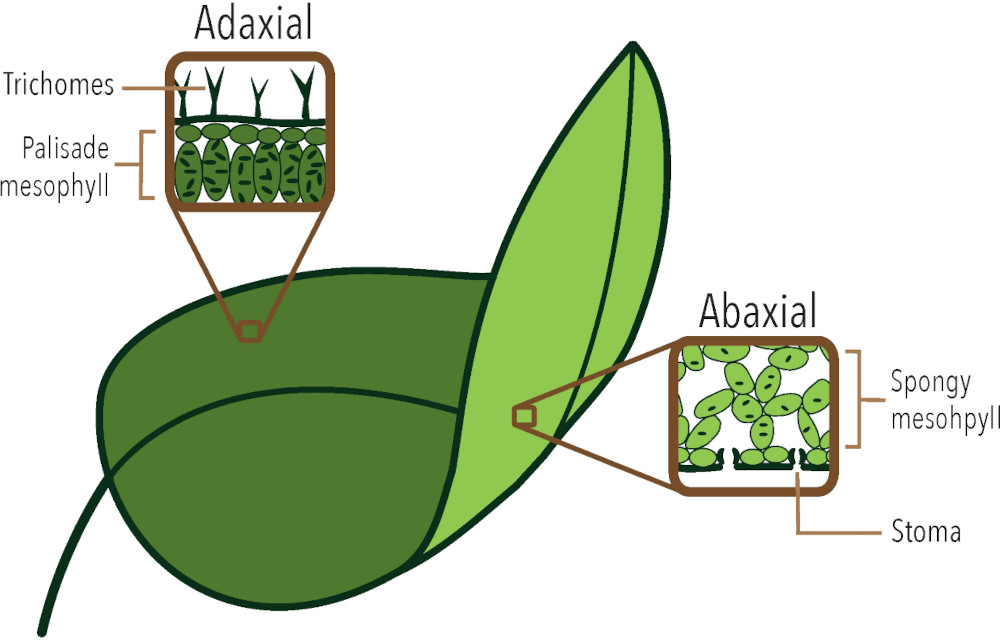 Adaxial Surface refers to the upper surface of a leaf facing toward the shoot axis. Adaxial Surface is useful when comparing fig leaves because leaf shape can vary by cultivar, tree age, shoot vigor, and season. Clear leaf descriptions should mention the part being observed and should be paired with photos when the term is used for identification.