Glossary
| Chloroplast |
Chloroplast means the cellular structure where photosynthesis occurs in practical plant language.. . Chloroplast is most useful when it is tied to the exact plant part, season, cultivar, and growing conditions being described. |
| Chlorosis |
Chlorosis is yellowing of plant tissue caused by reduced or uneven chlorophyll. It may appear between leaf veins, across an entire leaf, on older leaves, or on new growth depending on the underlying cause. In figs, chlorosis can be associated with nutrient availability, high soil pH, overwatering, root stress, cold soil, pests, disease, or normal leaf aging. The pattern matters: iron-related chlorosis often appears on newer leaves, while nitrogen deficiency is more likely to show first on older foliage. |
| Circling Roots |
Circling Roots means roots growing around the inside of a pot in practical plant language. Circling Roots is especially relevant to fig propagation. Growers use the term when judging whether plant material is forming healthy roots, joining properly, or staying vigorous enough to become a stable young tree. |
| Cleft Graft |
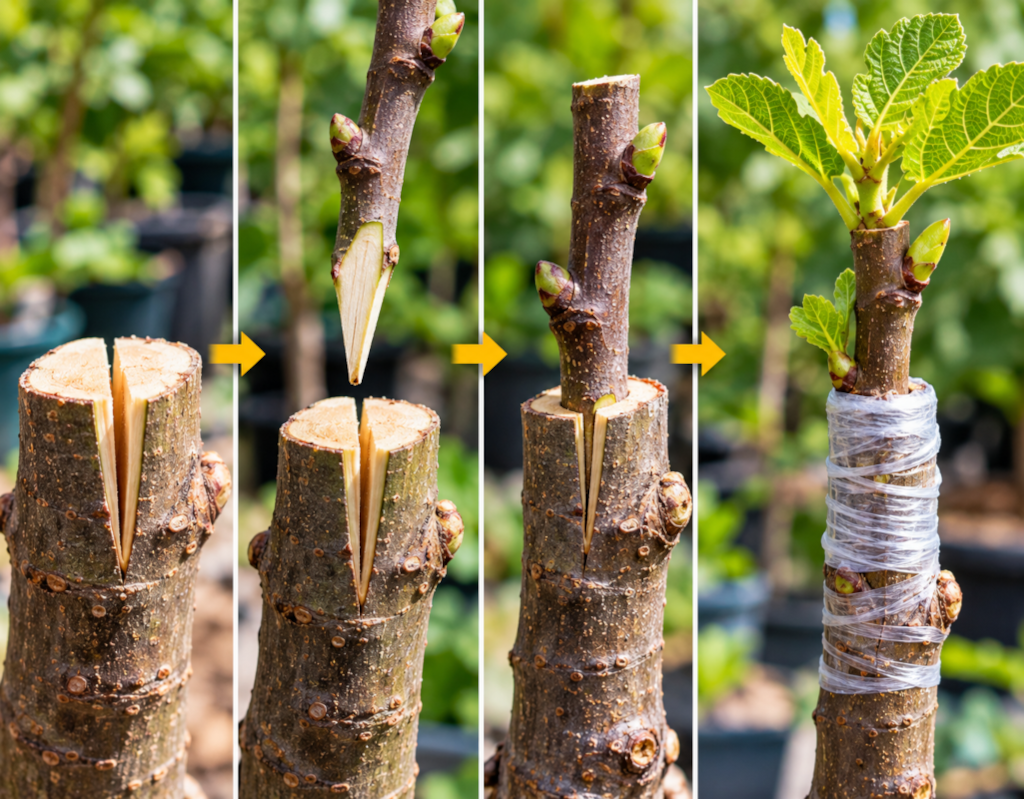
Cleft grafting is a plant propagation technique used to join a cutting, known as a scion, from one fig variety (Ficus carica) onto an established plant called the rootstock. The process involves making a vertical split in the cut end of the rootstock and inserting a scion that has been shaped into a tapered wedge. At least one side of the scion's cambium layer must align with the rootstock's cambium to allow the tissues to heal and form a successful graft union. The graft is then secured with grafting tape or another suitable material and protected from drying out while the two sections grow together. For fig growers and collectors, cleft grafting is a useful method for growing multiple fig varieties on a single tree, preserving desirable cultivars, or changing an established tree to a different variety without starting from scratch. It is commonly performed during dormancy or near the beginning of active growth, depending on local conditions. Successful grafting requires healthy plant material, clean cuts, proper cambium alignment, and protection against moisture loss. Once the graft union heals, the scion develops new shoots and eventually produces fruit characteristic of its original variety, while the rootstock continues to provide the supporting root system. |
| Clonal Propagation |
Clonal Propagation refers to propagation that preserves the genetics of a parent plant. Clonal Propagation is especially relevant to fig propagation. Growers use the term when judging whether plant material is forming healthy roots, joining properly, or staying vigorous enough to become a stable young tree. |
| Clone Name |
Clone Name means a name used for a clonally propagated selection in practical plant language.. . Clone Name is most useful when it is tied to the exact plant part, season, cultivar, and growing conditions being described. |
| Closed Eye |
Closed Eye is a term used for an ostiole that appears tight or sealed.. . When describing Closed Eye, use fruit at a known ripeness stage and note whether it is breba or main crop, since weather, pollination, and harvest timing can change the observation. |
| Coevolution |
In horticulture, Coevolution describes reciprocal evolutionary change between interacting organisms.. . Coevolution is most useful when it is tied to the exact plant part, season, cultivar, and growing conditions being described. |
| Cold Acclimation |
In horticulture, Cold Acclimation describes seasonal development of cold tolerance. . For Cold Acclimation, the practical interpretation depends on the growing setup: container or in-ground tree, drainage, watering pattern, sunlight, season, and local weather. |
| Common Fig |
Common fig refers to a type of Ficus carica that can set and ripen fruit without pollination by the fig wasp. This ability is often called parthenocarpy or persistence, and it is why common figs can be grown successfully in regions where the fig wasp is absent. Most backyard figs in many non-Mediterranean climates are common figs. The term describes pollination behavior, not fruit color, flavor, or quality. A common fig may be green, black, honey-flavored, berry-flavored, early, late, large, small, excellent, or ordinary depending on the cultivar. |
| Compost Mulch |
Compost Mulch is a term used for compost used as a surface mulch. . For Compost Mulch, the practical interpretation depends on the growing setup: container or in-ground tree, drainage, watering pattern, sunlight, season, and local weather. |
| Compost Tea |
Compost tea is a liquid extract made by steeping compost in water, sometimes with aeration or added foods intended to encourage microbial activity. Gardeners use it as a soil drench or foliar spray, though claims about its benefits vary widely. For fig growers, compost tea should not replace sound soil management, drainage, and balanced fertility. If used, it should be made from mature compost and handled carefully to avoid spreading unwanted organisms. Solid compost or mulch often provides more predictable benefits for soil structure and organic matter. |
| Container Culture |
Container Culture refers to growing a fig in a pot or container. . For Container Culture, the practical interpretation depends on the growing setup: container or in-ground tree, drainage, watering pattern, sunlight, season, and local weather. |
| Container Mix |
In horticulture, Container Mix describes a potting medium blended for container-grown plants. . For Container Mix, the practical interpretation depends on the growing setup: container or in-ground tree, drainage, watering pattern, sunlight, season, and local weather. |
| Container Volume |
Container Volume refers to the amount of growing space inside a pot. . For Container Volume, the practical interpretation depends on the growing setup: container or in-ground tree, drainage, watering pattern, sunlight, season, and local weather. |
| Container-Friendly |
Container-Friendly means well suited to container growing in practical plant language. . For Container-Friendly, the practical interpretation depends on the growing setup: container or in-ground tree, drainage, watering pattern, sunlight, season, and local weather. |